
How Automated Lead Follow-Up Infrastructure Increases SME Conversion Rates

Your service business is a bucket. Your marketing efforts pour valuable leads into it. But if you look closely, you’ll notice it’s leaking. Each drip is a prospect who inquired but never heard back, a warm lead that went cold, an opportunity lost to a more responsive competitor. The common reaction? Buy a bigger, shinier CRM. That’s like trying to patch a structural crack with masking tape.
The problem isn’t the bucket; it’s the absence of plumbing. You lack a system. A true automated lead follow up for service businesses isn’t a series of email templates; it’s an integrated infrastructure designed to capture, process, and convert every single opportunity with precision and predictability. It’s the difference between manually carrying water and having a fully pressurized system delivering it exactly where it’s needed.
Most agencies will sell you more marketing to pour more water into your leaky bucket. At EVOLIA STUDIO, we build the infrastructure that makes your business watertight. We architect the systems that turn marketing spend into measurable, scalable growth.
TL;DR: The Infrastructure-First Approach to Lead Follow-Up
- Manual Follow-Up Is a System Failure: Relying on human memory, spreadsheets, and sticky notes to manage leads is not a process; it’s a bottleneck that guarantees lost revenue and inconsistent client experiences.
- A CRM Is Not a Strategy: A Customer Relationship Management tool is just a database. Without a defined workflow architecture and robust CRM automation, it’s a passive repository, not an active growth engine.
- Infrastructure Precedes Automation: Effective automation is the result of a well-designed system. Simply connecting apps creates digital chaos. A solid infrastructure ensures every automated action serves a strategic purpose.
- Speed and Structure Win: The first-mover advantage is real. An automated infrastructure ensures near-instant, personalized engagement, dramatically increasing the probability of converting a lead before your competitors even see the notification.
- Data Is the Output of a System: You can’t optimize what you don’t measure. A proper lead management system provides clear data on response times, conversion bottlenecks, and pipeline velocity, enabling intelligent business decisions.
The Hidden Cost of Inefficient Lead Management
Every missed lead has a tangible cost equal to your customer acquisition cost (CAC). But the true damage of poor lead management runs far deeper, creating systemic drag on your entire business. This isn’t just about inefficiency; it’s about actively eroding your growth potential.
The structural inefficiency lies in treating follow-up as a series of discrete tasks instead of a continuous, integrated process. When a lead arrives from your website, social media, or a referral, what happens? For most service businesses, the « process » is a frantic, manual scramble. The founder gets an email, forwards it to a sales rep, jots a note down, and hopes for the best.
This manual approach introduces three critical points of failure:
- Time Decay: The value of a lead decays exponentially. A delay of just 30 minutes can decrease the odds of conversion by a factor of 21. Your manual process, by its very nature, builds in delays that kill opportunity.
- Process Inconsistency: Two different team members will handle the same lead type in two different ways. This creates a chaotic customer experience and makes it impossible to identify what’s working. One prospect gets a professional email, another gets a delayed WhatsApp message. Your brand perception becomes a game of chance.
- Data Vacuum: Without a centralized system logging every interaction, you are flying blind. You don’t know your average lead response time, your follow-up frequency, or where leads are getting stuck in your pipeline. You cannot make strategic decisions about your sales process because you have no reliable data.
This is the core of what we call a weak digital growth infrastructure. It forces you to work *in* your business, chasing individual leads, instead of *on* your business, optimizing the system that handles them all.
The Architecture of a Robust Automated Lead Follow-Up System
Building a resilient lead follow-up system is an exercise in architecture, not app selection. It requires designing a logical flow that accounts for every stage of the initial engagement. Before we even consider tools, we map the infrastructure, which consists of four distinct layers.
1. The Capture Layer
This is the entry point. It’s more than just a contact form on your website. The Capture Layer must centralize all lead sources—website forms, social media DMs, chatbot inquiries, manual entries—into a single, structured data stream. The goal is to eliminate data silos from day one. A lead from your professional website development in Dubai should be processed with the same rigor as one from a LinkedIn message.
2. The Processing & Logic Layer
Once captured, a lead enters the brain of the system. This layer is where raw data becomes actionable intelligence. It involves:
- Normalization: Cleaning and standardizing data (e.g., formatting phone numbers, capitalizing names).
- Enrichment: Appending additional data where possible (e.g., company size, industry).
- Qualification & Routing: Applying business rules to score the lead and route it to the right person or sequence. A high-value inquiry for a premium service should trigger a different workflow than a general question.
3. The Action Layer
This is where the automation becomes visible. Based on the decisions made in the Processing Layer, the Action Layer executes a series of pre-defined tasks. This is not just « sending an email. » It’s a multi-channel, context-aware sequence that could include:
- An immediate, personalized email confirmation.
- An internal notification to the assigned sales representative via Slack or Teams.
- The creation of a deal and associated tasks in your CRM.
- Scheduling a follow-up SMS message if no email response is received within 24 hours.
4. The Reporting & Monitoring Layer
This layer closes the loop. It tracks the performance of the entire system, logging every action and outcome. It provides clear dashboards on key metrics like lead response time, contact rate, and stage-by-stage conversion. This is the intelligence hub that allows you to identify bottlenecks and continuously refine the infrastructure for peak performance.
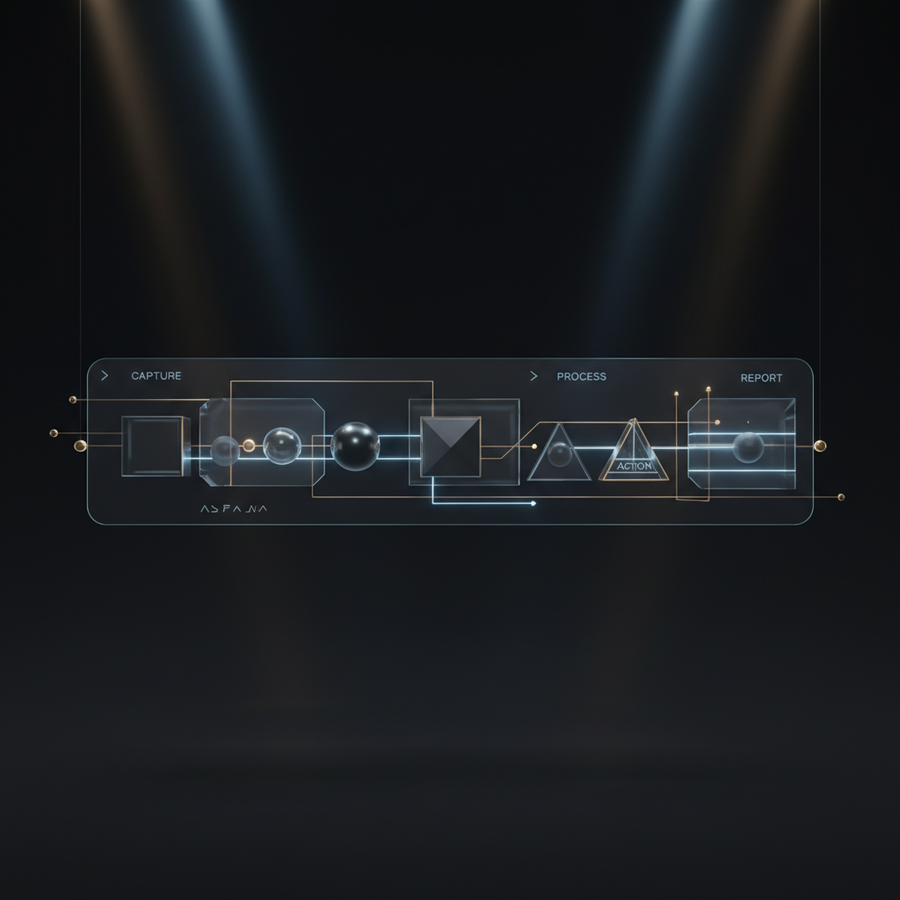
Practical Workflow Architecture: Automated Lead Follow-Up System
Conceptual layers are important, but translating them into a functional workflow is where infrastructure takes shape. Below is a high-level, business-focused breakdown of a core automated lead follow up for service businesses. This is not a technical tutorial on n8n workflow automation; it’s the strategic blueprint our architects design before a single line of code is written or a tool is configured.
Workflow Objective: To ensure every new website lead is captured, qualified, responded to, and logged within 5 minutes, 24/7, without human intervention.
- Trigger: A new lead submits the primary contact form on the company website.
- Data Normalization: The system immediately parses the submitted data. It standardizes the phone number format for future SMS communication, capitalizes the prospect’s name for personalization, and validates the email address format.
- Initial Qualification: The workflow checks the « Service of Interest » field. If the value matches a pre-defined list of high-value services (e.g., « Full System Redesign »), the lead is flagged as « Priority. »
- Decision Logic: The system evaluates the « Priority » flag.
- If Priority = True: Route to the « High-Value Lead » sequence.
- If Priority = False: Route to the « Standard Inquiry » sequence.
- Actions (High-Value Sequence):
- Instantly create a new Deal, Contact, and Company in the CRM.
- Assign the Deal to the Head of Sales and create a « Call within 1 hour » task.
- Send an immediate, personalized email to the prospect from the Head of Sales’ address.
- Send a notification to a dedicated Slack channel with the lead’s details for immediate team visibility.
- Logging: Every single action—from the initial form submission to the Slack notification—is logged as a note in the CRM contact’s timeline, creating a perfect, auditable history of engagement.
- Monitoring: A failsafe is initiated. If the CRM task « Call within 1 hour » is not marked as complete within 75 minutes, an escalation notification is sent to a manager to ensure nothing falls through the cracks.
This is not a simple « zap. » It is a resilient, intelligent process. It ensures speed, consistency, and accountability, transforming your lead follow-up from a liability into a competitive advantage.
Your current process is likely costing you more than you think. Let’s run a diagnostic on your digital infrastructure. Book a complimentary 30-minute infrastructure review call.
Implementation & Risk: Why DIY Automation Fails
Armed with this knowledge, the temptation is to subscribe to a few automation tools and start building. This is the single biggest mistake service business owners make. It leads to a fragile, disconnected web of automations that is difficult to manage, impossible to scale, and prone to silent failure.
Automation without architecture is digital duct tape. You end up with dozens of individual automations that don’t speak to each other. When one breaks, the entire sequence can fail without you even knowing. The underlying issue is a failure to prioritize the system over the tools.
A successful implementation follows a strict hierarchy:
- Strategy First: Define the business goals. What is the ideal client journey? What are the rules of engagement?
- Architecture Second: Design the infrastructure. Map out the layers, the data flow, and the logic, just as we did above.
- Tools Third: Select the components. Now, and only now, do you choose the right CRM, the right automation platform (like n8n for its flexibility), and the right communication channels to execute the pre-defined architecture.
Skipping the first two steps is like starting construction on a house by buying a pile of bricks with no blueprint. The result is inevitably a mess. A robust lead management system is the product of deliberate design, not accidental assembly.
FAQ
What is automated lead follow-up?
Automated lead follow-up is not just an email sequence. It is a structured system, or infrastructure, that uses technology to manage the entire initial engagement with a new lead. It includes instant response, data capture, qualification, CRM logging, and internal team notifications, ensuring speed and consistency without manual effort.
Why does manual lead follow-up fail in service businesses?
Manual follow-up fails due to inherent human limitations. It’s slow, inconsistent, and prone to error. Leads get forgotten, response times vary, and there is no reliable data for improvement. As a business grows, this manual system becomes a major bottleneck that throttles scalability and causes significant revenue leakage.
How long does it take to implement a lead follow-up infrastructure?
The timeline depends on complexity, but a foundational lead follow-up infrastructure can be designed and deployed in 2-4 weeks. This includes strategy, architecture design, tool configuration, and testing. The goal is to build a solid foundation that can be expanded upon, rather than a quick-fix solution that will break under pressure.

Conclusion: Stop Patching Leaks, Build an Engine
The persistent trickle of lost leads is a symptom of a deeper problem: a lack of sound digital architecture. You have spent time and capital generating interest in your services. To let that interest evaporate due to slow, inconsistent, or non-existent follow-up is a critical business failure.
Continuing to rely on manual processes is a strategic choice to accept inefficiency and limit your growth. The alternative is to invest in a permanent solution: a robust, automated lead follow-up infrastructure that transforms your lead generation efforts into a predictable revenue engine.
This isn’t about adding more apps or software. It’s about engineering a system that gives you control, visibility, and a decisive competitive edge. It’s about building an asset that works for you 24/7, ensuring no opportunity is ever wasted again.
Ready to move beyond manual follow-up and architect a system for growth? Schedule your strategic infrastructure call with EVOLIA STUDIO today.