
User Journey vs User Flow for Service Business Conversion
Your team is debating the merits of a three-step versus a four-step contact form. Someone brings up the “user flow,” while another argues it harms the “user journey.” The conversation is now stuck in a semantic swamp, and the project has lost momentum. This is not a debate about terminology. It’s a symptom of a deep, structural flaw in how service businesses approach their digital presence.
Confusing these two concepts is more than an academic error; it’s a strategic failure that leads to disjointed customer experiences, leaky sales funnels, and wasted marketing spend. The real question isn’t about the definition of user journey vs user flow. It’s about whether your website is an isolated digital brochure or the central hub of a coherent, automated Digital Growth Infrastructure.
Most web design agencies focus on creating clean user flows. We architect the entire growth system that gives those flows purpose and profitability.
TL;DR: The Core Distinction and Its Consequences
- User Journey is Strategic: It’s the entire map of your client’s relationship with your brand, from the first moment they realize they have a problem to becoming a long-term advocate. It spans multiple channels and months, focusing on motivations and emotions.
- User Flow is Tactical: It’s the specific, clickable path a user takes on your website to complete a single task, like booking a consultation or downloading a case study. It’s about screens, buttons, and fields.
- The Critical Error: Designing user flows without a master user journey blueprint is like designing a single room without the architectural plans for the entire building. The room might be beautiful, but it will be disconnected from everything else.
- The Business Cost: This disconnection leads to « journey friction. » A lead submits a form (a completed flow) but enters a black hole because the flow isn’t architected to connect with your CRM, sales automation, and follow-up sequences (the rest of the journey).
- The Infrastructure Solution: A robust Digital Growth Infrastructure ensures every tactical user flow is a purposeful, integrated component of the overarching strategic user journey, converting prospects into clients efficiently.
The Strategic Blind Spot: Why This Confusion Kills Conversions
Service businesses don’t sell widgets in a single transaction. They sell expertise, trust, and outcomes over a considered, multi-touch sales cycle. Your prospect’s decision isn’t made on a single landing page; it’s made over weeks or months of interactions.
The user journey accounts for this reality. It maps the prospect’s emotional state, questions, and doubts at each stage:
- Awareness: They encounter your thought leadership on LinkedIn.
- Consideration: They visit your website to understand your process.
- Evaluation: They download a case study to see proof of your results.
- Decision: They book a consultation call.
- Onboarding: They receive their welcome package and first invoice.
A user flow, by contrast, might only map the « Evaluation » or « Decision » step on the website itself. When you build your site focusing only on isolated flows, you create a jarring experience. The tone of your LinkedIn content doesn’t match your website’s messaging. The form they fill out asks for information they assume you already have. This is journey friction, and it is the silent killer of conversions in high-value service businesses.
User Journey vs User Flow: An Infrastructure Perspective
Let’s dismantle this common misunderstanding from an architectural standpoint. We aren’t just comparing two UX diagrams; we are comparing the blueprint of a skyscraper to the wiring diagram for a single floor.
User Journey: The Strategic Blueprint for Growth
Think of the User Journey as the master plan for your entire client acquisition and service delivery system. It is not a website-specific document. It is a business architecture document that dictates how marketing, sales, and operations intersect.
A properly architected User Journey defines:
- Touchpoints: Every interaction a client has, from a social media ad to a final project report.
- Channels: Where these interactions happen (e.g., website, email, CRM, sales calls).
- Data Flow: What information is captured at each stage and how it informs the next interaction.
- Emotional State: The prospect’s mindset, from uncertain and skeptical to confident and ready to invest.
- Success Metrics: The key business outcome for each major phase of the journey (e.g., qualified lead, signed contract, successful onboarding).
The journey map dictates the *why* behind every digital interaction. It ensures your entire system is built around your client’s reality, not your internal departmental silos.
User Flow: The Tactical Execution Path
A User Flow is a granular, technical specification for a task within one of your touchpoints—most commonly, your website. It is the tactical implementation of a single step within the grand strategic journey.
An effective User Flow details:
- Entry Points: How a user arrives at the start of the flow (e.g., from a blog post, a Google Ad).
- Steps & Actions: The specific pages they see and the buttons they click.
- Decision Points: Conditional logic, like showing different options based on a previous selection.
- Exit Points: Where the user goes after completing or abandoning the flow.
- Micro-Conversions: The successful completion of the task (e.g., form submitted, video watched).
A well-designed user flow ensures a specific task is intuitive and frictionless. But without the strategic context of the journey, it’s just a slick interface leading nowhere of consequence.
From Disconnected Paths to an Integrated Growth Infrastructure
The solution is to stop thinking in terms of « building a website » and start thinking in terms of « architecting a growth system. » Your website is not the system; it is the user-facing interface for the system.
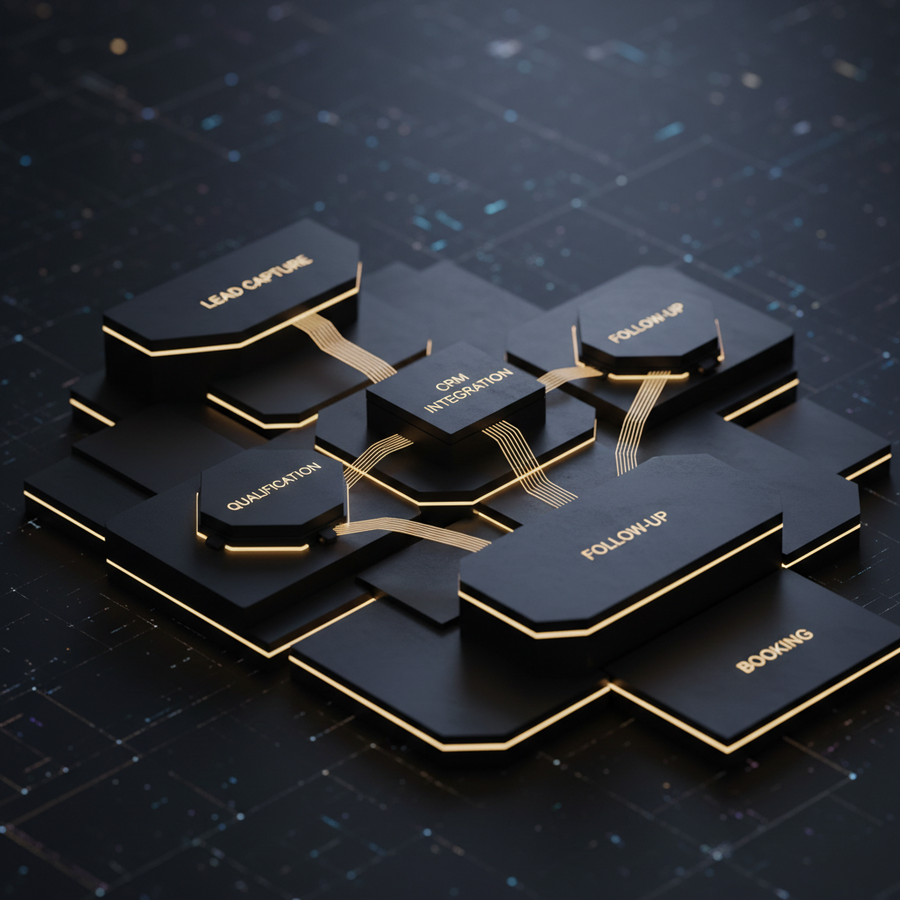
An infrastructure-first approach ensures that every user flow is a meticulously engineered component. When a user completes the « Book a Consultation » flow, the system doesn’t just send a notification. The infrastructure behind it triggers a cascade of automated, intelligent actions:
- The data is instantly and correctly passed to your CRM.
- The lead is tagged based on the service page they were on.
- A pre-call resource email is triggered from your workflow automation engine.
- Your sales team sees the new lead in their dashboard with a complete history of the prospect’s website interactions.
This is the difference between a static website and a dynamic growth engine. The flow is merely the trigger; the infrastructure does the heavy lifting. This systematic approach is the core of effective website development for service businesses that are serious about scale.
Your website may look professional, but are the systems behind it leaking revenue? A 30-minute infrastructure audit with our team can reveal the hidden friction points in your client acquisition process. Book Your Complimentary Infrastructure Review.
The High Cost of a « Flow-First » Approach
Starting with user flows—a « design-first » or « website-first » methodology—is the default for most agencies. It’s also dangerously shortsighted and expensive.
When you build a website as a collection of aesthetically pleasing but disconnected flows, you are baking inefficiency into your business. You create assets that cannot scale because they are not connected to a central operational logic.
The consequences include:
- Wasted Ad Spend: You pay to drive traffic to landing pages with « optimized » flows, but the leads generated are handled manually and inconsistently, destroying your ROI.
- Lead Leakage: Prospects fill out forms but get slow or irrelevant responses because the data isn’t being routed intelligently. They lose confidence and go to a competitor.
- Inaccurate Data: Without a unified journey map, you can’t track a client’s full lifecycle. You make critical business decisions based on incomplete and fragmented analytics.
- Operational Drag: Your team spends hours manually transferring data between your website, your email marketing tool, and your CRM, introducing errors and delays at every step.
True conversion path design isn’t about the color of a button. It’s about architecting a seamless, automated system that guides a prospect from curiosity to closing with precision and momentum.
FAQ
What is the main difference between user journey and user flow?
The main difference is scope and perspective. A user journey is a strategic, high-level map of the entire customer relationship across all channels over time. A user flow is a tactical, low-level diagram of the specific steps a user takes to complete one task on one platform, like your website.
Why is user journey mapping critical for a service business?
It’s critical because service sales are built on trust and a considered decision-making process. A user journey map allows you to design every touchpoint—from your content to your follow-up emails—to address your prospect’s questions and anxieties at each stage, building the confidence needed to invest in a high-value service.
Can you have a good user flow without a user journey map?
Yes, you can design a user flow that is visually clean and easy to use in isolation. However, without the strategic context of a journey map, that flow will likely be a « dead end. » It won’t be integrated with your other systems (like CRM and sales automation), leading to a broken overall experience for the customer and operational problems for your team.
Conclusion: Stop Building Pages, Start Architecting Systems
The debate over user journey vs user flow is a distraction. Focusing on it is a sign that your perspective is too narrow. The path to scalable growth is not paved with prettier contact forms or smoother checkout flows alone. It’s built on a foundation of a robust, intelligent Digital Growth Infrastructure.
The user journey is your architectural blueprint. The user flows are the individual circuits and pathways within that structure. Building one without the other is an exercise in futility. One gives you a system with no interface; the other gives you an interface with no system.
It’s time to elevate the conversation from pixels and pages to systems and structure. When you are ready to build an infrastructure that doesn’t just look good, but actively grows your business, the distinction becomes self-evident. You’ll have built a system where every flow serves the journey.
Let’s architect your growth. Schedule a call with an EVOLIA strategist today.